About the Tour
As you journey through the each gallery, click on each track to uncover fascinating facts about the species and their habitats. Listen to the introductory track below for detailed instructions.
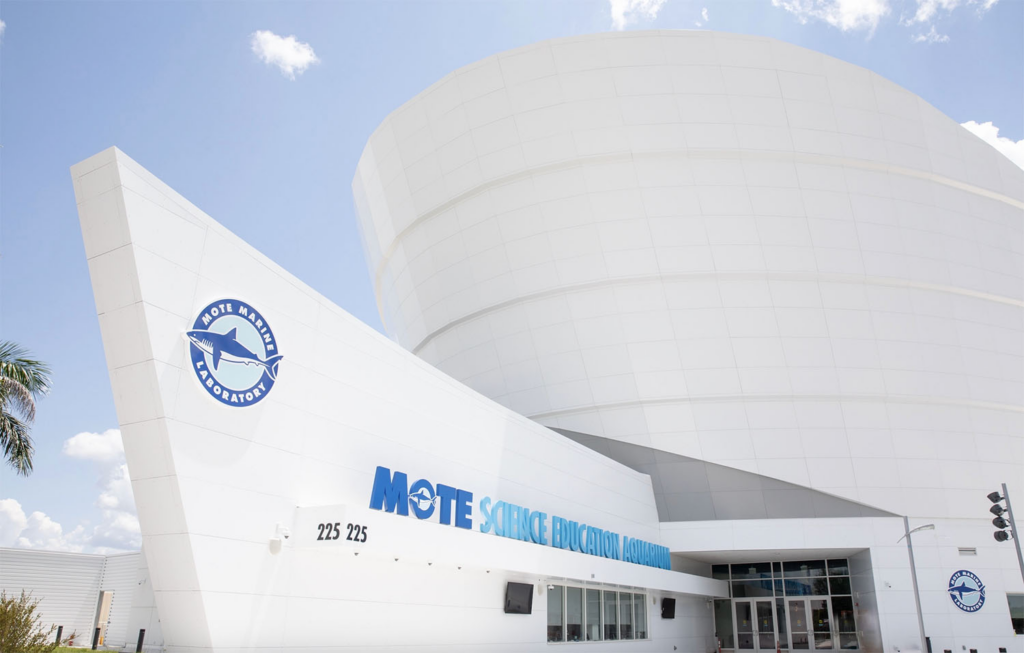
Welcome to Mote SEA, our Science Education Aquarium! To enhance your experience, we’ve made it easy to access additional information at our exhibits and laboratories. Each exhibit contains a tactile QR code. When the QR code is scanned with a mobile device, you’ll be taken to an audio version of the exhibit content. Each exhibit’s unique QR code will automatically play the audio guide for that exhibit. Since each exhibit has its own unique QR code, you can explore in any order that interests you. Take your time, follow your curiosity, and enjoy learning at your own pace.
If you have any questions about using our audio guide, or if you want more information about Mote’s history, animals, research, or special activities and events, our friendly volunteers (wearing bright, teal colored shirts) are stationed throughout the aquarium and would be happy to assist you.
We hope you enjoy your time exploring Mote SEA learning about incredible animals and ecosystems, the dedicated people who study them, and the important work being done to protect our oceans.
Explore all three floors at Mote SEA with the help of these engaging audio tracks.
Floor 1
Mote History
As you first enter the aquarium, find the Mote History wall to your left.
Welcome to Mote’s History Wall! Listen along to a timeline starting with our humble beginnings all the way up to the opening of Mote’s Science Education Aquarium!
In the 1930s, Eugenie “Genie” Clark fell in love with fishes as a child visiting her local aquarium.
In 1955, Anne and William H. Vanderbilt provided funding for Genie to open the Cape Haze Marine Laboratory in Placida, Florida. She became its Founding Director.
Three years later, in 1958, Genie conducted behavioral and biological studies of sharks, demonstrating for the first time sharks’ ability to respond to training.
In 1960, the Lab moved from Placida to Siesta Key in Sarasota, Florida, and only two years later Mote launched its first educational summer program offering high schoolers practical experience with marine biology.
In 1965, Charles M. Breder, Jr. served as interim Director, and a year later Dr. Sylvia Earle served as interim Director.
An important change took place in 1967 when the Lab was renamed Mote Marine Laboratory in honor of William R. Mote and his sister, Betty Mote Rose. Over time, new studies unfolded on estuarine ecology, red tide, toxicology, sharks, dolphins, biomedical research, and more. That same year, Dr. Perry Gilbert began serving as Director.
Another big move took place in 1978 when the Lab moved from Siesta Key to City Island, Sarasota. That same year, Dr. William H. Taft began serving as Director.
In 1980, Mote Marine Science Center opened to educate the public about the marine environment. It was later renamed Mote Aquarium.
Two years later, Mote began monitoring sea turtle nesting on Sarasota County beaches, an effort that continues today and supports conservation of these endangered reptiles.
As early as 1984, Mote was the first to characterize red tide toxins that affect human health. Also that year, Drs. Kumar Mahadevan and Richard Pierce began serving as interim co-Directors. In 1985, Dr. Robert F. Dunn served as Director, followed by Dr. Kumar Mahadevan in 1986.
In 1989, Mote surveys resulted in the inclusion and protection of Sarasota Bay in the National Estuary Program.
In 1991, the United States Congress established the Mote Center for Shark Research as a national focal point to conduct research and outreach on shark ecology, fisheries, and conservation. Two years later, in 1993, Mote established its first research facility in the Florida Keys on Pigeon Key.
In 1996, Mote carried out its first experimental release of common snook to evaluate survival patterns of hatchery-reared fish.
Mote’s Tropical Research Lab on Summerland Key opened in 2000.
In 2002, Mote Aquaculture Research Park (MAP) opened, hosting its first fish. Aquaculture research began with sturgeon and extended into other species over time, including closing the life cycle of common snook.
In 2004, Mote conducted the first detailed surveys of blue holes—previously unstudied environments that play an important role in the Gulf ecosystem.
2008 was a big year for Mote. Mote planted its first corals to restore coral reefs in the Florida Keys. Mote also began collecting data on three species of endangered rays: spotted eagle rays, manta rays, and devil rays.
In 2010, the BP Deepwater Horizon oil blowout in the Gulf demanded urgent research by Mote scientists.
That same year, Dr. Michael Crosby joined Mote as Senior Vice President for Research, and Mote launched its 2020 Vision & Strategic Plan.
In 2013, Mote’s Board of Trustees appointed Dr. Crosby as President & CEO of Mote Marine Laboratory & Aquarium.
That same year, Mote scientists joined forces with the Combat Wounded Veteran Challenge and youth divers from SCUBAnauts International to restore coral reefs.
In 2014, Dr. Crosby and Genie dove in the Gulf of Aqaba on her 92nd birthday as part of Mote’s International Marine Science Diplomacy Initiative in the Middle East.
Oceans of Opportunity: The Campaign for Mote Marine Laboratory launched on Mote’s 60th anniversary in 2015 and raised over $50 million to fulfill Mote’s 2020 Vision & Strategic Plan.
In 2017, Mote opened the new Elizabeth Moore International Center for Coral Reef Research & Restoration (also known as IC2R3) on Summerland Key.
In 2018, generous philanthropic investment from The Andrew and Judith Economos Charitable Foundation established the Red Tide Institute at Mote.
To further Mote’s red tide research, a year later the State of Florida partnered with Mote to launch the Florida Red Tide Mitigation & Technology Development Initiative to fight the impacts of red tide with innovative science and technology.
In 2020, Mote launched its Beyond 2020 Vision & Strategic Plan.
That same year, Mote scientists were the first to document fragments of slow-growing, reef-building corals restored with Mote-pioneered technology reaching sexual maturity and spawning in their natural settings in just five years instead of decades. Also in 2020, the International Coral Gene Bank was established at Mote Aquaculture Research Park (or map, for short) in Sarasota County to serve as a “Noah’s Ark” for coral, housing the widest array of coral genetic diversity on the planet outside of Mother Nature herself.
2020 was also the year Mote broke ground for Mote Science Education Aquarium (Mote sea).
In 2022, over 50 shark species were added to the Convention on International Trade in Endangered Species of Wild Fauna and Flora (also called sighties) protected list — a decision informed by Mote research.
That same year, Mote celebrated 30 years of operations in the Florida Keys with expansion into the Upper Keys to extend Mote’s science-based coral reef restoration efforts throughout the entirety of Monroe County — from Key Largo to Key West.
In 2023, Mote and the State of Florida joined forces with other partners to launch the Seagrass Restoration Technology Development Initiative to develop and test sustainable, cost-effective methods for restoring coastal seagrass.
In 2025, Mote Science Education Aquarium (Mote SEA) opens to welcome visitors and inspire the next generation of marine scientists!
Thank you for listening! The history you’ve learned is only the beginning. Keep exploring to uncover the science, innovation, and dedication driving ocean discovery today and shaping a healthier future for our seas.
Floor 1
STEM Teaching Labs
Mote SEA’s three STEM Teaching Labs immerse learners of all ages in hands-on marine science—from ecosystems and animal health to cutting-edge technology—bringing real Mote research to life through exploration and discovery.
Welcome to Mote SEA’s three stem teaching laboratories. Designed to spark curiosity and imagination, these dynamic learning spaces bring decades of Mote research to life through exploration and discovery. Guests won’t just learn about science—they’ll live it. Each lab combines engaging activities with real research translated by Mote’s scientists and educators into experiments and investigations that people of all ages and scientific backgrounds can understand and undertake. Together, these opportunities invite learners to explore new ideas, test possibilities, and see themselves as the next generation of researchers, innovators, and conservationists.
In the Marine Ecology Lab, learners explore mangroves, seagrass, and coral reefs, connecting to Mote’s work in restoration and aquaculture. The Biomedical and Immunology Lab highlights ocean animal health and its links to human medicine, from shark immunity to bioactive marine microbes. The Ocean Technology Lab showcases the innovative tools of marine science, including electronic tags, autonomous vehicles, A.I., and citizen science apps. From coastal ecosystems to animal health to cutting-edge technology, each lab opens a window into a different part of Mote’s research.
Thank you for learning about our three innovative stem teaching labs, where we provide immersive, hands-on experiences in a real-world marine context for learners of all ages! To explore programs offered in the Mote sea stem teaching laboratories, visit mote.org/education.
Floor 1
Trailblazers in STEM
As you first enter the aquarium, find the Trailblazers in STEM interactive on the wall to your right.
Diversity powers innovation. Mote honors the resilience and contributions of past and present scientists from populations that are underrepresented in stem fields. Their determination and innovation have transformed many aspects of our lives. By embracing diverse backgrounds and perspectives, Mote enriches the field of marine science and works toward a brighter future for our oceans. We are deeply grateful to these and many other trailblazers for their remarkable achievements, often realized despite significant challenges.
Mote strives to educate tomorrow’s trailblazers. Expanding access and opportunities in marine science is a top priority at Mote Marine Laboratory. As part of this commitment, Mote leads initiatives designed to support and empower future innovators in the field. In 2019, the National Science Foundation awarded Mote Marine LAboratory the lead role in the Marine Science Laboratory Alliance Center of Excellence (mar-sci-lace ), a program dedicated to increasing participation in marine stem.
Through mar-sci-lace and other initiatives, Mote strives to break down barriers and create pathways for individuals who have historically had limited access for opportunities in marine science. Explore the interactive screen to meet some of our trailblazers, and visit mote.org/education to discover how you can join the next wave of innovators shaping the future of marine science!
Floor 1
Marine Science and Tech Digital Hub
As you first enter the aquarium, find the Resource Center directly to your right.
Welcome to the Marine Science and Technology Digital Hub! This is your portal to unique library and educational resources! These include: teaching curricula, scientific publications, Dr. Eugenie Clark Archival Collection, Susanna Dudley Macroalgae Herbarium, photos, videos, and more!
To learn more or to make an appointment, scan the QR code or visit Mote.org/digital hub!