

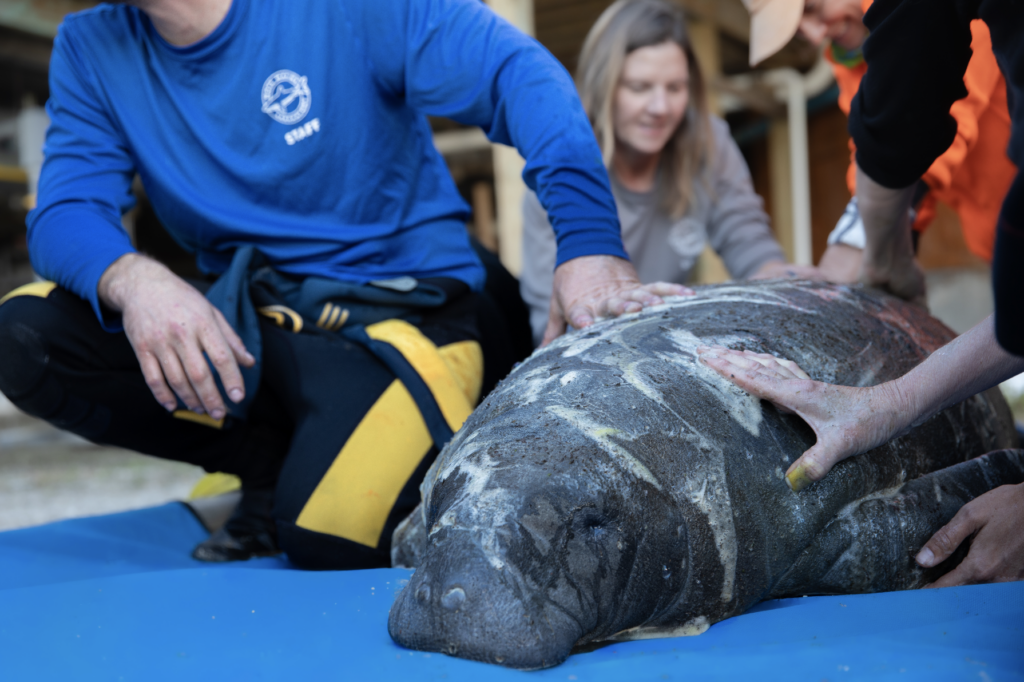
Mote Marine Laboratory is responding to a recent cold weather event affecting multiple marine species across Florida, rescuing three young, cold-stressed Florida manatees and receiving 25 cold-stunned green sea turtles transferred from Florida’s east coast. The animals are currently housed at Mote’s Sea Turtle and Manatee Rehabilitation Hospital, where they are receiving specialized care and ongoing monitoring as part of their rehabilitation process.
Cold stressing and stunning are potentially life-threatening conditions caused by sudden or prolonged drops in water temperature. Many marine animals rely on their surrounding environment to help regulate body temperature, and when waters become too cold, their metabolic and physiological functions can slow dramatically. Affected animals may become lethargic, disoriented, or unable to swim or forage effectively, leaving them vulnerable to predators, vessel strikes, and secondary health complications such as infection or pneumonia. Young animals are particularly at risk due to limited energy reserves, making rapid rescue and rehabilitative care critical during cold-weather events.
The three cold-stressed manatees were rescued directly from Bear Creek in Pinellas County. The first manatee, a young male, was rescued on Tuesday, January 27, with the remaining two (a young female and young male) rescued on Thursday, January 29. Florida Fish and Wildlife Service, Bishop Museum of Science and Nature, Eckerd College Search and Rescue, Florida Wildlife Research Institute, and ZooTampa at Lowry Park helped facilitate the rescues.
In 2024, Mote was designated as a secondary care holding facility for manatee rehabilitation under the direction of the U.S. Fish and Wildlife Service (USFWS) and the Florida Fish and Wildlife Conservation Commission (FWC). However, due to ongoing over-capacity conditions at Florida’s primary critical care manatee facilities, Mote’s designation was recently updated to light-critical care, which allows the patients to come directly to Mote’s rehab facility. Mote answering the call allows more space to be available primary care facilities for more critical patients.
In addition to the manatees, Mote received 25 cold-stunned green sea turtles on Tuesday, February 3. The turtles were transferred from Florida’s east coast as part of a coordinated, statewide response to the current cold front with assistance from FWC and the Conservation Team with Disney’s Animals.
“When cold-stressing and stunning occur, the ability to respond quickly and effectively is critical,” said Lynne Byrd, Rehabilitation & Medical Care Manager of Mote’s Sea Turtle and Manatee Rehabilitation Hospital. “Mote’s facilities, protocols, and experienced staff allow us to provide high-quality rehabilitative care during periods when multiple species are impacted at the same time.”
With cold weather events occurring, Mote will remain actively engaged in rescue and rehabilitation efforts, providing care to affected animals as capacity and resources allow. In response to the unusually high number of cold-stressed and stunned animals, Mote staff are dedicated to providing critical services despite there being no federal or state designated funding, with Mote committing internal resources to meet urgent animal welfare needs. These ongoing responses reflect Mote’s dedication to applying marine science and clinical expertise to real-world conservation challenges, particularly during periods of heightened environmental stress.
Mote’s marine animal rescue and rehabilitation efforts build on decades of experience through its federally permitted animal hospital and the Stranding Investigations Program, which, combined, have responded to thousands of dolphins, whales, sea turtles, and sea turtle hatchlings.
Mote’s programs operate under federal permits and focus on the rescue, rehabilitation, release, and scientific investigation of marine animals to improve conservation outcomes for wild populations.
Updates on the animals’ conditions will be shared as appropriate in coordination with USFWS and FWC.