Nurse shark
Nurse sharks range from yellow-tan to brown, blending into the sandy ocean floor. They have two sensory barbels near their mouths, helping them detect prey in the sand. Unlike many sharks, their small,...
You are using an outdated browser. Please upgrade your browser to improve your experience.
Nurse sharks range from yellow-tan to brown, blending into the sandy ocean floor. They have two sensory barbels near their mouths, helping them detect prey in the sand. Unlike many sharks, their small,...
Sandbar sharks are gray-brown with a tall, triangular dorsal fin and long, broad pectoral fins, helping them glide efficiently through coastal waters. They prefer sandy or muddy bottoms in shallow areas...
Three juvenile nurse sharks, Ginglymostoma cirratum, were examined weekly for 3 yr to document rates at which teeth, marked by clipping the cusps of newly exposed teeth, moved from the innermost to the outermost row and were eventually...
During elasmobranch ontogeny, increasing body size has been proposed to result in a tradeof between increased sensitivity and decreased spatial resolution of the electrosensory system, but this hypothesis has not previously been tested....
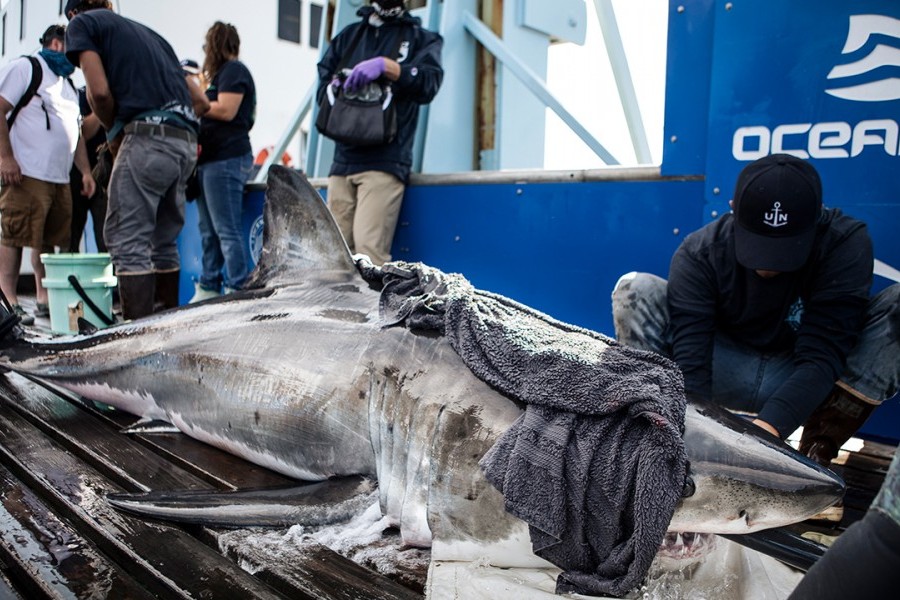
Length at life stages of the white shark Carcharodon carcharias is not well known for most of the 9 populations of this species, including in the western North Atlantic (WNA). We analyzed length and maturity data by sex for 87 white...
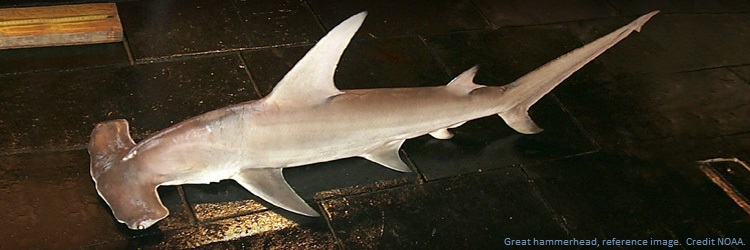
Hammerhead sharks (Family Sphyrnidae) comprise a monophyletic Miocene radiation of carcharhiniform sharks characterized by their laterally expanded and dorsoventrally compressed head (‘cephalofoil’). The bonnethead shark (Sphyrna...
Climate change is shifting animal distributions. However, the extent to which future global habitats of threatened marine megafauna will overlap existing human threats remains unresolved. Here we use global climate models and habitat...
Blacktip reef sharks have silvery-gray dorsal sides and white bellies. Eluded to in their name, these reef sharks have dark black spots on the end of all of their fins, including their tail. They are fast and agile, frequently leaping...
Horn sharks get their name from the two distinct ridges protruding from their head. They are slow-moving, bottom-dwelling sharks that use their pectoral fins to "walk" along the seafloor. With strong, molar-like teeth, they are...
Nurse sharks have not previously been known to migrate. Nurse sharks of the Dry Tortugas (DRTO) mating population have a highly predictable periodic residency cycle, returning to the Dry Tortugas Courtship and Mating Ground (DTCMG)...
Members of the subclass of fishes collectively known as elasmobranchs (Class Chondrichthyes, Subclass Elasmobranchii) include sharks, skates, rays, guitarfish, and sawfish. Having diverged from the main line of vertebrate evolution...
Measuring the metabolic rate of animals is an essential part of understanding their ecology, behaviour and life history. Respirometry is the standard method of measuring metabolism in fish, but different respirometry methods and systems...
Researchers from Mote Marine Laboratory, Florida International University, University of Miami and many scientists across the globe have discovered two areas of concern after analyzing small shark fins...
A hammerhead shark species discovered by scientists finally has a name and its namesake is the late Paul G. Allen, philanthropist and co-founder of Microsoft. The existence of the new species, Sphyrna alleni, was hidden because...
Epaulette Sharks are known for their ability to "walk" on the ocean floor using their pectoral and pelvic fins, which is unique among sharks. They prefer hiding in crevices and caves during the day and are more active at night when...
Coral cat sharks have color-changing abilities that allow them to adapt to different environments— from sandy sea floors to coral reefs. These sharks are mostly nocturnal, hunting for small fish and invertebrates at night.They...
These sharks are named for the dark shading on the tip of their snout, which is more prominent in juveniles and fades with age. They have slender, yellowish-gray bodies with countershaded (paler) bellies.
Bonnethead sharks are grayish-brown with distinctive shovel-shaped heads. During migration, they often travel in large schools, sometimes numbering in the hundreds or thousands!
Zebra sharks get their name from the coloration they exhibit as juveniles. Juvenile zebra sharks have brown and white stripes, but as they get older, their pattern lightens to become tan with dark brown leopard-like spots. The upper...
Sand tiger sharks have an intimidating appearance, with rows of long, needle-like teeth visible even when their mouth is closed. Despite their fierce look, they are slow-moving and docile toward humans....
The swell shark is a small, nocturnal species of shark. They have large mouths, extending past their eyes. Swell sharks have a broad head and stout body. They are a yellowish brown color, with a pattern of large dark blotches and...
Whitetip reef sharks are a smaller species of shark, with grayish brown coloration and a distinctive white tip on their dorsal and caudal (tail) fins. They are a mostly nocturnal species, and are often found resting on the seafloor...
Silky sharks have long, slender bodies, with a dark gray or bronze coloration and white belly. They have a distinctive rounded dorsal fin, and a rounded snout. Their dermal denticles, similar to scales, are tightly packed and overlapping,...
It is assumed that complex life cycles in cnidarian parasites belonging to the Myxozoa result from incorporation of vertebrates into simple life cycles exploiting aquatic invertebrates. However, nothing is known about the driving forces...
Although white sharks (Carcharodon carcharias) have been considered rare in Atlantic Canada waters, recent sighting records indicate a potentially increasing presence. We combine historical to present sighting data with satellite telemetry...
Results from published age and growth models for bonnetheads (Sphyrna tiburo) indicate significant differences in life history between populations in the eastern Gulf of Mexico (GOM) and those in estuarine waters of the Atlantic coast...
Our global analysis estimated the overlap and fishing exposure risk (FEI) using the space use of satellite-tracked sharks and longline fishing effort monitored by the automatic identification system (AIS). In the accompanying Comment,...
Our previously published paper provided global fine-scale spatiotemporal estimates (1° × 1°; monthly) of overlap and fishing exposure risk (FEI) between satellite-tracked shark space use and automatic identification system (AIS)...
Natural mortality, M, is a key parameter for the assessment and management of living resources but is difficult to observe directly. Therefore, M is often estimated indirectly from life history traits, and it is typically assumed to...
Understanding how mobile, marine predators use three-dimensional space over time is central to inform management and conservation actions. Combining tracking technologies can yield powerful datasets over multiple spatio-temporal scales...