


What is the best PCR protocol for my agency to ID sharks and rays?
Led by Mote’s Dr. Demian Chapman (also an adjunct at Florida International University) and FIU biologist Dr. Diego Cardeñosa, portable and cost-effective PCR testing is revolutionizing science-based enforcement and driving international collaboration in shark conservation. Use the decision tree below to determine what type of PCR is the best for your shark product (e.g., fins) identification needs and capacity. Please contact Dr. Demian Chapman (dchapman@mote.org) for any questions or a consultation on how to establish PCR testing in your shark product inspections.

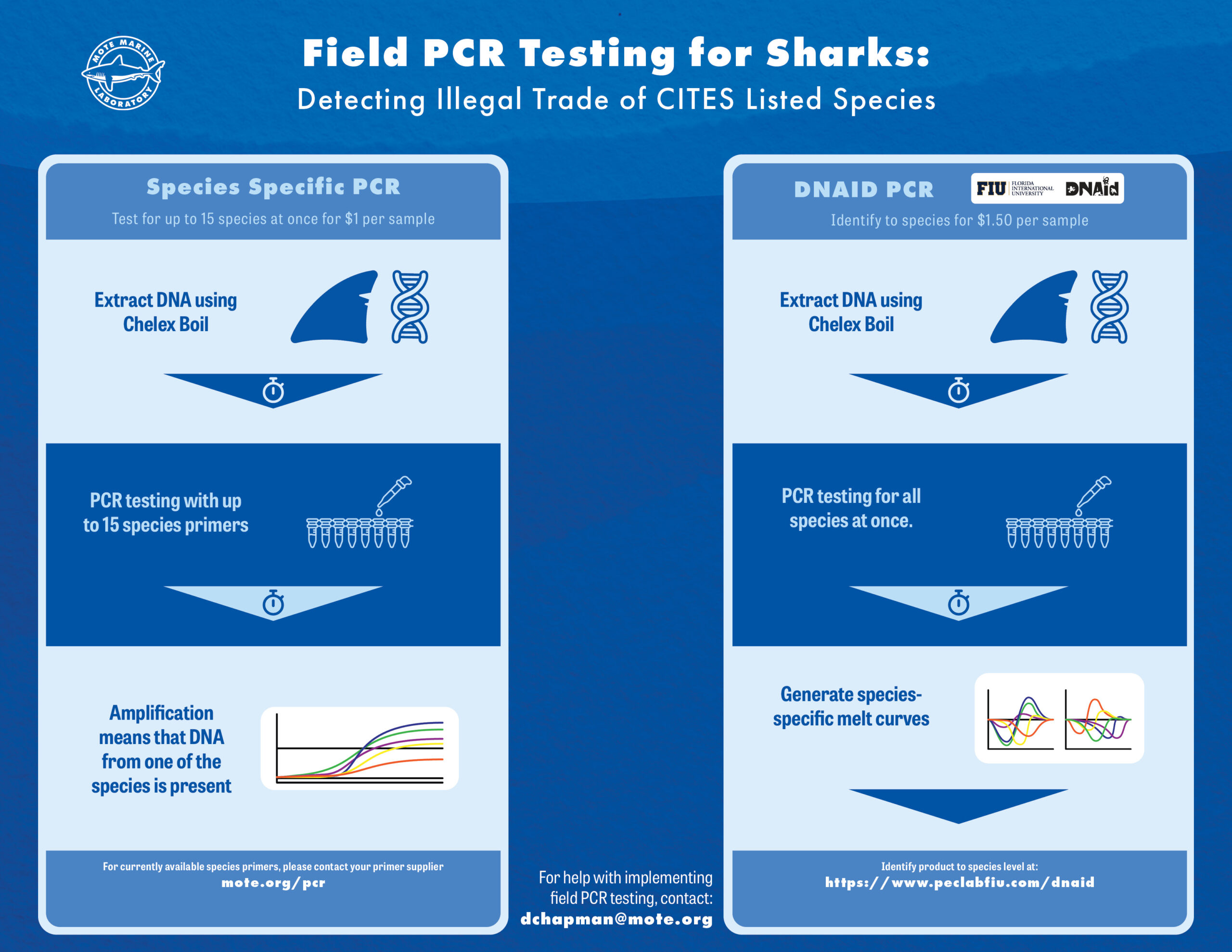
Information on species-specific PCR to detect CITES-listed species

Species specific PCR involves using a set of primers that are designed to amplify a particular species or set of species. PCR of this kind can be run on any conventional thermal cycler and visualized using agarose gel electrophoresis. It can also be run on any real time thermal cycler that will detect amplification itself. The cost of species-specific PCR is likely to be ~ $1USD per sample, but the drawback is if the sample does not originate from a species with a primer then it will not be identified.
Species-specific PCR tests have been developed and validated for many CITES-listed sharks and rays that are common in the fin trade.
Species-specific PCR tests
Scalloped hammerhead, smooth hammerhead, great hammerhead, silky, porbeagle, bigeye thresher, pelagic thresher, common thresher sharks: Cardeñosa, D., Quinlan, J., Shea, K.H. and Chapman, D.D., 2018. Multiplex real-time PCR assay to detect illegal trade of CITES-listed shark species. Scientific Reports, 8(1), p.16313.
Basking shark: Magnussen, J.E., Pikitch, E.K., Clarke, S.C., Nicholson, C., Hoelzel, A.R. and Shivji, M.S., 2007. Genetic tracking of basking shark products in international trade. Animal Conservation, 10(2), pp.199-207.
All sharpnose sharks (Family Rhizopriondon): Pinhal, D., Shivji, M.S., Nachtigall, P.G., Chapman, D.D. and Martins, C., 2012. A streamlined DNA tool for global identification of heavily exploited coastal shark species (genus Rhizoprionodon). PLoS One, 7(4), p.e34797.
Blue, silky, dusky-oceanic whitetip-Galapagos, porbeagle, shortfin mako, longfin mako: Shivji, M., Clarke, S., Pank, M., Natanson, L., Kohler, N. and Stanhope, M., 2002. Genetic identification of pelagic shark body parts for conservation and trade monitoring. Conservation Biology, 16(4), pp.1036-1047.
Rhino rays (i.e., all rays with shark-like fins): Chapman, D.D., Cardeñosa, D., Shea, K.H., Babcock, E.A., Jabado, R.W., Zhang, H., Gale, S.W. and Feldheim, K.A., 2025. Ongoing trade of fins from critically endangered rays (wedgefish and giant guitarfish) despite international regulations and a novel PCR test to detect rays among ‘shark’ fins. Conservation Genetics, pp.1-11.
Many of the commonly traded requiem sharks (i.e., Family Carcharhinidae) including spinner (Carcharhinus brevipinna), blacktip complex (C. limbatus and C. tilstoni), blacknose (C. acronotus), bull (C. leucas), Caribbean reef (C. perezi), night (C. signatus), sandbar (C. plumbeus, bignose (C. altimus), Java (C. amboinensis), gray reef (C. amblyrhynchos), spottail (C. sorrah), Atlantic lemon (Negaprion brevirostris):
Henning, M., 2005. Highly Streamlined PCR-Based Genetic Identification of Carcharhinid Sharks (Family Carcharhinidae) for Use in Wildlife Forensics, Trade Monitoring, and
Delineation of Species Distributions. Master’s thesis. Nova Southeastern University. Retrieved from NSUWorks, Oceanographic Center. (117) https://nsuworks.nova.edu/occ_stuetd/117.
Nielsen, J.T., 2004. Molecular Genetic Approaches to Species Identification and Delineation in Elasmobranchs. Master’s thesis. Nova Southeastern University. Retrieved from NSUWorks, . (278). https://nsuworks.nova.edu/occ_stuetd/278.
For access to any of these publications or assistance with using them yourself please contact Dr. Demian Chapman (dchapman@mote.org)
Universal PCR test: DNA ID
The universal PCR test DNA ID uses a single set of primers and protocol to identify a shark sample to the species level no matter what species it comes from. Unlike species-specific PCR that provides a positive or negative finding for a selected subset of species, DNA ID provides a clear species determination. DNA ID offers a fast, cost-effective, and accurate method for identifying elasmobranch species—sharks, rays, and skates—using PCR. Designed to support conservation enforcement and combat illegal wildlife trade, this assay distinguishes species by analyzing the unique melting behavior of PCR products generated from DNA isolated from any type of tissue (e.g., fins, meat, skin). Validated across hundreds of vouchered specimens, the protocol can be run in the field and is optimized for high-throughput processing at a cost of $USD1.50 per sample. DNA ID currently identifies over 80 elasmobranch species commonly encountered in trade, with ongoing efforts to expand coverage.
Local Sea Turtle Nest Counts