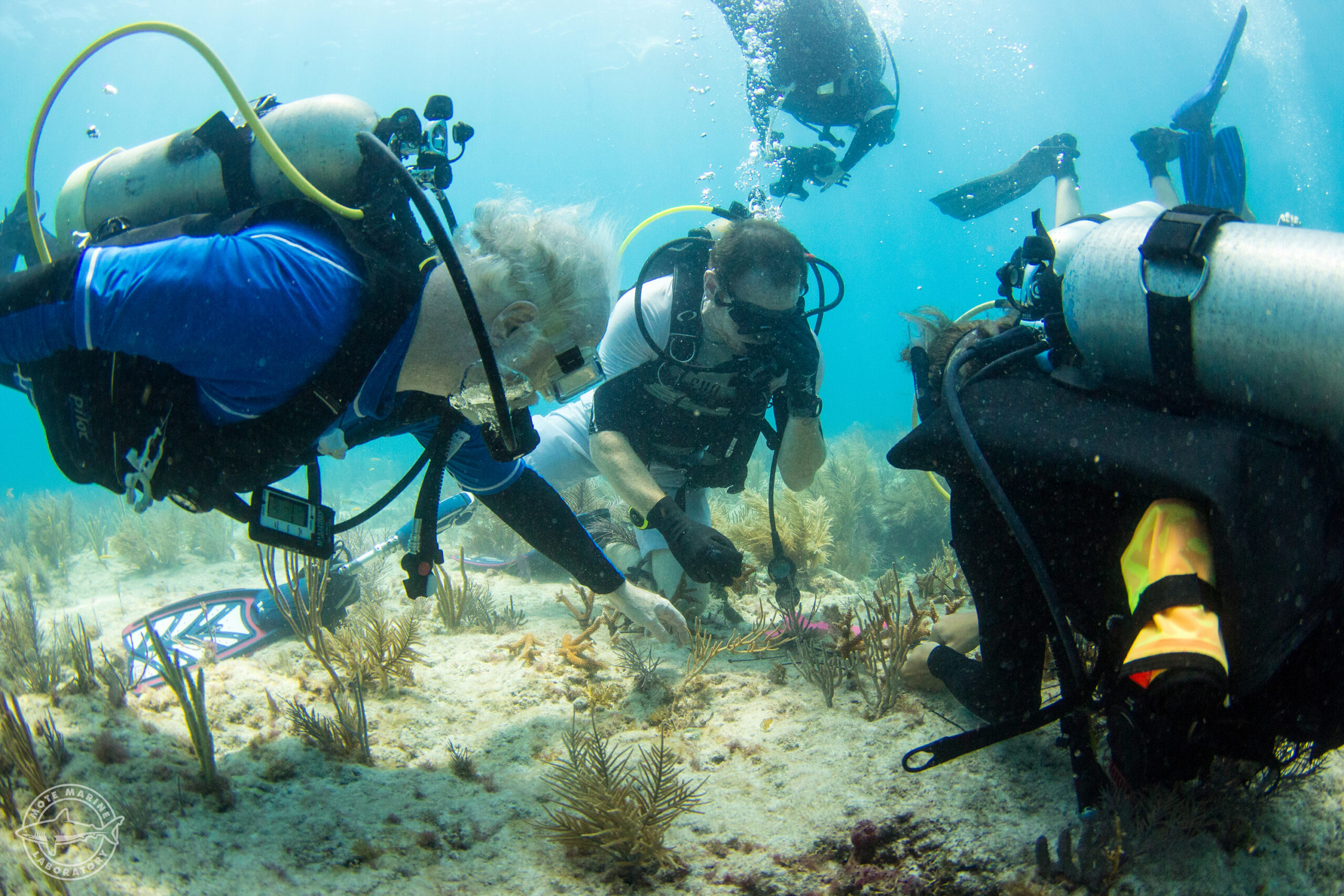
The Florida Keys BleachWatch program is designed to train and coordinate volunteers who regularly report on the occurrence, or absence, of coral bleaching, as well as basic environmental conditions from various reef sites throughout the Florida Keys. This rapidly reported observational data is then synthesized with existing NOAA remote sensing and environmental monitoring data to provide the scientists and resource managers with a summary of actual “current conditions” on the reef throughout the summer months. This information will allow researchers to further develop the accuracy of available coral bleaching predictions and assist resource managers to better communicate the condition of the reefs as potential bleaching events occur, as well as integrating the information into existing management plans.
Participating Divers: Skip to Training & Reports Below
Coral Bleaching
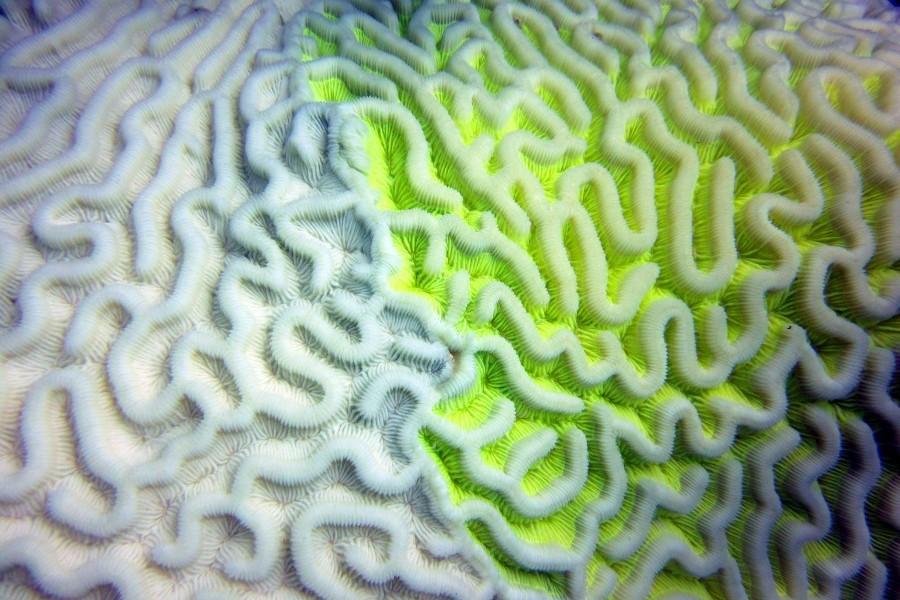
Coral bleaching is a stress response in which corals lose their symbiotic algae (zooxanthellae), or the algae’s photosynthetic pigments. These algae provide stony corals with most of their energy and are responsible for much of their vibrant color. When bleaching occurs, the coral’s white calcium carbonate skeleton becomes visible through its transparent tissues, giving the coral a bright white appearance.
Although bleached corals are still alive, they have lost a major source of energy and must rely more heavily on capturing food with their tentacles. This alternative source of nutrition is often insufficient to sustain corals over the long term. If stressful conditions persist for weeks to months, corals can become increasingly weakened, experience reduced growth and reproduction, and ultimately die.
Coral bleaching is one of the greatest threats to coral reef ecosystems worldwide. While some level of bleaching naturally occurs during periods of elevated summer temperatures in the Florida Keys, records show that the frequency, extent, and severity of bleaching events have increased dramatically since the 1980s. This trend is closely linked to climate change, which is driving higher ocean temperatures—the primary cause of widespread coral bleaching. Mass bleaching events can have devastating consequences for reef ecosystems and the coastal communities, economies, and fisheries that depend on them.
BleachWatch Mission
The Florida Keys BleachWatch Program, modeled after Great Barrier Reef’s BleachWatch, is a team of trained recreational, commercial and scientific divers who help monitor and report on conditions at the reefs. Divers are provided an underwater wristband to use as a reference and a reminder key below and above the water.
After each visit to the reef, the divers submit a report to the BleachWatch Coordinator.
Due to Florida reefs and portions of the Caribbean reefs experiencing an outbreak of stony coral tissue loss disease, BleachWatch observers are also encouraged to also collect data on disease and no disease at their sites. These observations will help researchers try to understand the range, progression, and species affected. Please visit The Florida Keys National Marine Sanctuary for more information.
Participating Divers
Thank you for helping us monitor and report conditions on Florida’s Coral Reef! Below are links to submit reports and access training and other resources. For questions, please contact us at: bleachwatch@mote.org
Current Conditions
Information from NOAA’s Coral Reef Watch (CRW) remote sensing and Integrated Coral Observing Network (ICON) in-situ environmental monitoring analysis are combined with “BleachWatch” volunteer observations in the field to provide a comprehensive overview of “current conditions” throughout the FKNMS. These reports will be generated according to the current conditions and the potential risk for coral bleaching and are listed below:
LATEST REPORT: AUGUST 25: EXTREMELY HIGH
2026 Incoming Reports Map
Below is a Google map (updated weekly) of reports from the year so far. Filter reports by bleaching and disease, and click individual points to see photos and more information.
Past Condition Reports
- 2026: May 27-LOW, June 26-MODERATE, July 13-HIGH, JULY 28-EXTREMELY HIGH, AUGUST 11-EXTREMELY HIGH, AUGUST 25-EXTREMELY HIGH
- 2025: May 26-MODERATE, June 30-LOW, July 31-MODERATE, August 13-HIGH, August 27-HIGH, September 10-HIGH, September 24-HIGH, October 22- LOW, November 20-LOW
- 2024: May 28-LOW, July 1-LOW, August 5-HIGH, August 16-HIGH, August 30-HIGH, September 17-MODERATE, October 1-MODERATE, October 29-LOW
- 2023: June 1-LOW, June 30-MODERATE, July 14-HIGH, July 28-HIGH, August 11 EXTREMLY HIGH, August 25-EXTREMLY HIGH, September 13-HIGH, September 27- HIGH, October 12-LOW, November 2-LOW
- 2022: June 1-LOW, July 1-LOW, July 15-MODERATE, July 28-MODERATE, August 15-LOW, September 1-HIGH, September 19-HIGH, September 30-HIGH, October 31, 2022-LOW,
- 2021: June 1-LOW, July 1-LOW, August 2-MODERATE, August 18-MODERATE, September 3-LOW, September 23-LOW, October 21-LOW
- 2020: June 2-LOW, July 1-MODERATE, July 17-MODERATE, July 31-MODERATE, August 14-HIGH, August 28-HIGH, September 11-MODERATE, September 28-LOW, October 29-LOW
- 2019: June 3-LOW, July 1-MODERATE, July 17-MODERATE, August 2-MODERATE, August 17-HIGH, September 4-HIGH, September 20-LOW, October 21-LOW
- 2018: June 1-LOW, June 29-LOW, July 27-MODERATE, August 16-MODERATE September 10-LOW, October 8-LOW, November 1-LOW
- 2017: June 1-LOW, July 3-LOW, August 1-MODERATE, August 21-MODERATE, October 4-LOW, November 3-LOW
- 2016: June 1-LOW, July 1-LOW, July 15-MODERATE, August 1-LOW, August 30-LOW, September 22-LOW, October 25, 2016-LOW
- 2015: June 2-LOW, July 1-MODERATE, July 17-MODERATE, August 3-MODERATE, August 14-HIGH, August 28-HIGH, September 11-HIGH September 25-MODERATE, October 12-LOW, November 9-LOW
- 2014: May 30-LOW, June 30-LOW, August 1-MODERATE, August 14-MODERATE, August 28-HIGH, September 11-MODERATE, September 25-MODERATE, October 9-LOW, November 5-LOW,
- 2013: June 3-LOW, July 1-LOW, July 31-LOW, September 3-LOW, September 28-LOW, October 30-LOW
- 2012: June 1-LOW, July 2-LOW, August 2-MODERATE, August 17-MODERATE, September 6-MODERATE, September 27-LOW, October 25-LOW
- 2011: June 2-LOW, July 1-LOW, August 8-MODERATE, August 22-MODERATE, September 6-MODERATE, September 19-MODERATE, October 3-LOW, October 31-LOW
- 2010: June 1-LOW, July 1-MODERATE, July 23-LOW, August 6-MODERATE, August 20-MODERATE, September 3-MODERATE, September 17-MODERATE, October 1-LOW, November 1-LOW
- 2009: June 2-LOW, July 2-LOW, July 16-MODERATE, July 30-MODERATE, August 13-MODERATE, August 27-MODERATE, September 10-MODERATE, September 24-MODERATE, October 8-LOW, November 5-LOW
- 2008: June 2-LOW, June 30-LOW, August 1-LOW, August 15-MODERATE, September 1-MODERATE, September 26-LOW, October 30-LOW
- 2007: June 1-LOW, June 29-LOW, July 16-MODERATE, July 30-HIGH, August 13-HIGH, August 27-MODERATE, September 10-HIGH, October 1-LOW, October 30-LOW
- 2006: June 1-LOW, June 30-LOW, July 31-MODERATE, August 14-MODERATE, August 28-MODERATE, September 19-LOW, October 19-LOW
- 2005: June 1-LOW, June 28-LOW, July 26-MODERATE, August 9-HIGH, August 16-MODERATE, August 23-HIGH, August 30-MODERATE, September 13-MODERATE, September 27-LOW, October 18-LOW
For more information about BleachWatch or the current conditions reports, please contact the BleachWatch Coordinator at bleachwatch@mote.org. For coral bleaching reports in the Southeast Florida Region, please report to SEAFAN.
This project was funded by a grant awarded from Mote Marine Laboratory’s Protect Our Reefs Grants Program, which is funded by proceeds from the sale of the Protect Our Reefs specialty license plate. Learn more at www.mote.org//4reef.